
Rail thermal forces for jointed and CWR track
This is the presentation I gave to the West of England Section of the Permanent Way Institution:
This is the presentation I gave to the West of England Section of the Permanent Way Institution:

I feel very honoured and proud to see the article “An introduction to rail thermal force calculations” I wrote with my friend, Levente Nogy, published and featured on the front cover of the Journal of the Permanent Way Institution.
Joint resistance The normal rail joints are designed to allow the rail length variation due to temperature. To do this the joints have a well-defined maximum gap and a set of installation parameters to provide an optimum behaviour at temperature variation and a good maintenance regime. Any modern rail joint has a standard bolt tightening torque…

This is the presentation I gave to the Glasgow Section of the Permanent Way Institution: Track Quality Measurement and Inherent Design Standard Deviation Later note: Some fundamental things stated in this presentation need to be revised.

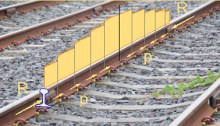
In the previous article, Jointed track breathing, was described for jointed track the complex activation phenomenon of the track resistance forces that oppose to rail thermal length variation. In the case of the jointed track this activation takes place on the entire length of the rail. As the rail length increases a greater temperature variation…

The crossing is the track arrangement which ensures the intersection of two opposite running edges of a turnout or diamond crossing. It usually has one crossing vee and two wing rails (BS EN 13232-1:2003). The crossing, in the common setup, has a gap section to allow the passage of the wheel flange on both directions. The safe…

Rail breathing Normally on the railway track the rail is fixed through a set of superstructure elements (fastenings, sleepers, ballast) that opposes the rail tendency to expand or contract due to temperature variations. This fixation is achieved through friction forces and once the rail axial forces are above these friction forces, the rail will start…

Note: This article presents the Joint Closure Temperature (JCT) for free thermal expansion (FTE) track superstructure ; it is directly related and should be read in conjunction with the following articles: When can a rail be called long? presenting the definition of the concepts long rail and short rail, from thermal behaviour perspective. Track longitudinal resistance presenting the two…
 A railway track blog