La voie ferrée

When it comes to Railway track engineering literature, there are a few books we can consider “classic”. Even old, some very old, these books still have significant railway engineering value and can be always a good reference both for young and inexperienced engineers as for the ones that already have robust railway track experience and…

How is the cant measured?

The good old times Since the early beginnings of the railway, the track engineers were aware of the centrifugal forces influence to the train riding when passing through a curved section of track. To compensate this influence, the track was inclined laterally by creating a positive level difference between the outer and inner rails of a…

Why a right hand curve is positive?

In transportation engineering there is the following signage convention  for curves in horizontal alignment design: a right hand curve is considered positive a left hand curve is considered negative This convention is considered relative to the stationing direction of that alignment. This signage convention is established in the following way (see the figure above):

Virtual Transition

This is an animation showing how a PWay Track Horizontal Alignment Virtual Transition is defined by the trajectory of the vehicle centre, when is passing over a railway track section with a sudden change in curvature: The nature of this curve is presented in this post: THE VIRTUAL TRANSITION CURVATURE VARIATION. More details about this principle…

Buckling prevention

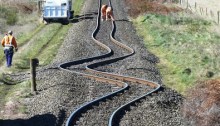
The track buckling happens in hot weather because of a multitude of factors but it is massively influenced by the track longitudinal and lateral resistances. Both these resistances have three levels of action: Figure 1. The three levels of track lateral and longitudinal resistance – between rail and fastening – at this level all the modern fastenings are behaving…

The limits of the track alignment design parameters

(A commented extract from BSEN 13803-1 (2010) Railway Applications – Track – Track alignment parameters – Track gauges 1435 and wider – Part 1: Plain Line) The track alignment design PARAMETERS (BSEN 13803-1 – 5.1.2) In the design process the values of the track alignment parameters are chosen to ensure a safe riding with at least…