Significance of jointed track parameter variation

Joint resistance The normal rail joints are designed to allow the rail length variation due to temperature. To do this the joints have a well-defined maximum gap and a set of installation parameters to provide an optimum behaviour at temperature variation and a good maintenance regime. Any modern rail joint has a standard bolt tightening torque…

Jointed track breathing

Rail breathing Normally on the railway track the rail is fixed through a set of superstructure elements (fastenings, sleepers, ballast) that opposes the rail tendency to expand or contract due to temperature variations. This fixation is achieved through friction forces and once the rail axial forces are above these friction forces, the rail will start…

Modern Railway Track

Motto: Tolle lege! Perhaps the best and most complete technical book about track is “Modern Railway Track” written by Dr Coenraad Esveld, Professor of Railway Engineering at Delft University of Technology.  A detailed Table of Contents of the second edition can be found here together with a brief selection of the book. The second edition, written…

When can a rail be called long?

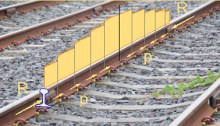
Thermal expansion When exposed to temperature variations, the rail tends to vary its length. If this tendency is freely allowed, for a temperature variance Δt°, the rail length L will vary by ΔL. This length variance can be computed as: ΔL = αLΔt° In this formula, α is the steel expansion coefficient = 11.5·10−6 mm/mm°C. If…

The limits of vertical acceleration

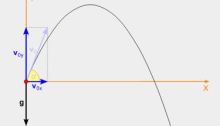
The theory of vertical movement. The parabolic projectile motion An object thrown in the air, near the earth’s surface, moves along a parabolic path under the action of gravity only. The only force of significance that acts on the object is gravity, which acts downward to cause a downward acceleration. Because of the object’s inertia, no external horizontal force is needed…