Virtual Transition

This is an animation showing how a PWay Track Horizontal Alignment Virtual Transition is defined by the trajectory of the vehicle centre, when is passing over a railway track section with a sudden change in curvature: The nature of this curve is presented in this post: THE VIRTUAL TRANSITION CURVATURE VARIATION. More details about this principle…
Buckling prevention

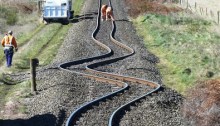
The track buckling happens in hot weather because of a multitude of factors but it is massively influenced by the track longitudinal and lateral resistances. Both these resistances have three levels of action: Figure 1. The three levels of track lateral and longitudinal resistance – between rail and fastening – at this level all the modern fastenings are behaving…

Numeri Regunt FerroVia

The track geometry is governed by numbers and all the time we are using them to design and check our work. The geometry of the non-linear transition curves is also governed by important numbers, useful to know in the alignment design when these transitions are used: – Bloss – Cosine (and its close approximation: the…

Bloss like a boss

(a prelude to a proper design guidance) Non-linear transitions and their use in alignment design  In alignment design the transition curves are used to provide a smooth variation of the centrifugal acceleration between alignment segments of different curvature. When needed, the cant transition is applied, in direct relation with the curvature variation of the transition…

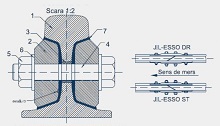
Reinforced Scarf Joint – JIL ESSO

In 2005-2006 at the Technical University of Civil Engineering Bucharest was designed for SUDAREC a special insulated scarf joint (IBJ), to be installed and used on the Romanian railway   sections of the Fourth Pan-European Corridor. The project included: – geometrical design of all the joint elements for 4 types of rail and 3 sectioning angles