One sleeper vs many – you will never guess which is stronger!

An interesting research shows a comparison between the lateral resistance tests undertaken on single sleeper and tests on multiple sleepers.
The results for single sleeper tests show a huge difference between the more complex shaped sleeper and the normal box shape (up to 60% increase in lateral resistance).
But reveals also something else ..

snippet – Lateral resistance before and after tamping

Things you find on Spark. In 1972, RTC conducted a series of tests to evaluate the effect on tamping on the track lateral resistance. Their results, published in 1973, have been referenced in numerous other research documents, including the ERRI D202 Reports – the committee that produced UIC Leaflet 720R “Laying and Maintenance of CWR…

How do the rails buckle?

Disclaimer – this includes a back-of-the-envelope calculation. Take it with a pinch of salt. If a steel beam is exposed to an increased temperature, it will tend to expand. If there is nothing to oppose that expansion, then the beam increases in length by ΔL. If, however, the beam’s ends don’t allow this expansion then…

Stress transition zones within CWR

The location of the stress transition zone is not only limited to the extremities of a continuous welded rail (CWR) track, the case presented in a previous article – CWR stress transition zone.  A stress transition zone may also be present between two fixed zones, inside the CWR. These internal stress transition zones are shorter…

Thermal forces and broken rails

Rail steel has a considerably higher carbon content (0.7-0.8%), and hence is more brittle than mild steel. A variety of stress concentrating defects in rails, combined with the alternating loads from the passage of traffic, can produce slowly propagating fatigue crack. When this crack attains a critical size it causes an almost instantaneous brittle fracture…

CWR stress transition zone

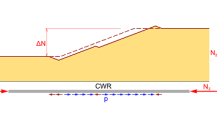
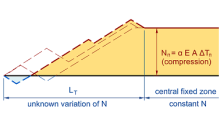
(prelude to a new PWI Journal article) A stress transition zone is any section of continuous welded rails (CWR) where the thermal force is variable, the longitudinal resistance (p) is active and rail movement occurs due to rail temperature variations. The most common (and well known) location of the stress transition zone is at the…