An interesting article published in 2007 and called “Dynamic vehicle response versus Virtual Transitions” mentions that the virtual transition concept was presented in a German railway publication as early as 1936, 16 years before the first documented record of this design rule in English papers (“Recent Developments in Railway Curve Design” – ICE – 1952).
I’m still looking for the article “Bewertung der Gleisverbindungen S 49 nach dem “Ruck”.” published in 1936 by R. Vogel in “Organ für die Fortschritte des Eisenbahnwesens in technischer Beziehung”. 91(20), (pp. 413-419.)
“Ruck” is an interesting German term – it means jolt or jerk. In the context of the virtual transition challenge I’m so obsessed with, a lateral “ruck” (jerk) is what is experienced when a railway vehicle passes over a point of sudden curvature change, a point so many of us improperly call “virtual transition”.
Digging for this German article or any other pointing to the origin of the concept of virtual transition in railway track alignment design, and trying to find the first document which describes the principle, I found the document below from 1915, describing a legal challenge of a German citizen who was thrown off a tram, when passing over a reverse curve:
J. A. Seuffert’s Archiv für Entscheidungen der obersten Gerichte in den deutschen Staaten – J.A. Seuffert’s Archive: Decisions of the Supreme Courts in the German states (1915)
Probably incidents like this one made the German engineers propose in 1936 a method of calculating the variation of the lateral acceleration at a sudden change of curvature, based on the length of a vehicle.
But let’s see what this document says:
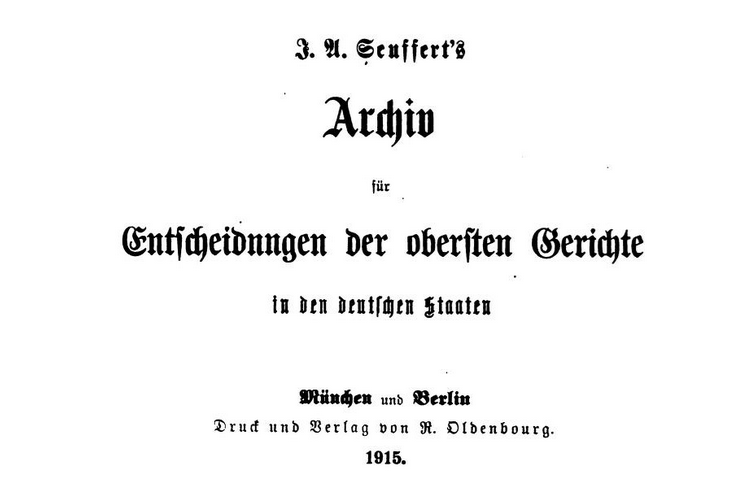

Nice letters. Makes equal sense to me as it does to you … so I translated this entirely by Google (this time is not my English, but google’s to blame):
“Railway liability for a passenger falling from the deck of a tram. Liability Act. § 1; German Civil Code. § 254.
I. On January 20, 1913, the plaintiff fell from the front platform (deck) of a trailer car of the Great Berlin Tramway while negotiating a curve. He demanded compensation for his damages from the railway company within the scope of the Liability Act. The Regional Court found half of the claim to be justified, while the Higher Regional Court found half to be justified. The appeals of both parties were dismissed. — From the reasons for the judgement:
…
On the other hand, the lower court also found negligence on the part of the plaintiff without any legal error. He explained that when travelling on a tram, one must almost always expect bends and curves, which cannot be negotiated without vibrations and shocks, that the plaintiff was not familiar with the route in question, and that he was also unable to see it from his place.

Because of the tram in front of him could overlook, so that he could not know in advance when impacts were to be expected. Nevertheless, he positioned himself in the apparently not completely secure place, without even attempting to hold on in any way, e.g., to the grab bar on the front wall of the vehicle. In this behaviour, the lower court judge rightly found a disregard for the care required in traffic. This negligence contributed to the accident. It is established that the tram was travelling quickly across the open Tempelhofer Feld and, upon approaching the double curve in front of the Ringbahn station, braked so sharply that the plaintiff had to put one foot forward, which then entering the curve, a lateral jolt (jerk) occurred, which catapulted the plaintiff from the vehicle onto the pavement, even though he tried to hold on to the front deck pole.”
If you travel by train you know…
I read this whilst travelling by train, in a modern coach with 17m between bogies, seated probably just above the front bogie. I’m right there, I can feel it!
Sometimes, when your seat is close to the bogie, above or beyond it, the ride can be quite shaky, if you are lucky. Well, dear reader, I was lucky!
And here is my train of thought:
Finally, I found something in German about lateral jerk – in 1915 a Berliner gentleman fell off the tram because of it passing over a virtual transition a point of sudden change of curvature…
… I’m reading his story and I’m drawing, with my incredible talent, the visual presentation of the incident; I will probably turn this into a blog post … I recall the very first challenge to the principle of virtual transition (raised in 1952 – read here the story):
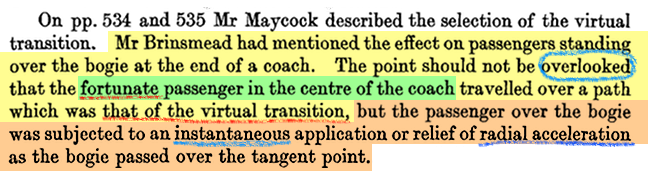
Today I’m not a “fortunate passenger”, but I’m lucky because a terrifying understanding hits me:
This challenge statement about the overlooked difference between the “fortunate passenger” in the centre of the coach and one seated over the bogie is not complex engineering or “rocket” science. It is common sense!
Anyone who travels by train knows this to be true – you will feel less the sudden changes of lateral acceleration if you sit in the centre of the coach than if you would be seated above the bogie. At different points inside the vehicle you will feel different lateral accelerations.
So, if we feel this in modern coaches, where, my friend, is the “virtual transition” the old 12.2m coach provides?
You know this, you felt it so many times: There is no transition for the people close to the bogies.
As we will see in a future article, you, dear reader, can easily check for yourself, there is no “transition” anywhere in the coach.
This “virtual transition” rule we are holding on for 75 years, a rule only a few other railways are using (for never-setting-sun reasons), this rule the Germans never adopted, this rule contradicts not only basic science, but also what we all feel when travelling by train and our common sense can clearly confirm – there is no “transition” in “virtual transition”!
(to be continued)
Discover more from A railway track blog
Subscribe to get the latest posts sent to your email.


 A railway track blog
And how must the virtual transition feel to the poor train driver, whose discomfort is often a source of rough ride reports? In many trains they have no choice but to sit in front of the bogie.
LikeLiked by 1 person
Thanks for your comment!
That is a very good point.
However, my story has a twist … I will not spoil it here now.
LikeLike