Supersonic train?

In which the author writes not about Hyperloop, as some readers might think, but about trains running at the speed of sound on very conventional railway track, hoping to repay in this way the readers for his so very long blogging absence. The author also hopes the last comma was sufficient for the readers to…

Stress transition zones within CWR

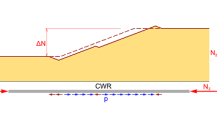
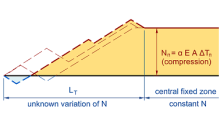
The location of the stress transition zone is not only limited to the extremities of a continuous welded rail (CWR) track, the case presented in a previous article – CWR stress transition zone.  A stress transition zone may also be present between two fixed zones, inside the CWR. These internal stress transition zones are shorter…

The shortest path …

A long time ago in a country far, far away … The King heard about a new marvel of engineering … in England was invented a monstrous machine. It was moving by its own, magically propelled by coal fire and hot steam! Its speed was higher than the quickest eagle or the fastest horse! It…

Vehicle rollover speed

The Santiago de Compostela derailment occurred on 24 July 2013, when a high-speed train, travelling from Madrid to Ferrol (north-west of Spain) derailed at high speed on a 400 m radius curve, at Angrois, in Santiago de Compostela. Around 140 people were injured and 79 died. Data from the train’s black box revealed that before the start of the curve the train was travelling at…

Thermal forces and broken rails

Rail steel has a considerably higher carbon content (0.7-0.8%), and hence is more brittle than mild steel. A variety of stress concentrating defects in rails, combined with the alternating loads from the passage of traffic, can produce slowly propagating fatigue crack. When this crack attains a critical size it causes an almost instantaneous brittle fracture…

CWR stress transition zone

(prelude to a new PWI Journal article) A stress transition zone is any section of continuous welded rails (CWR) where the thermal force is variable, the longitudinal resistance (p) is active and rail movement occurs due to rail temperature variations. The most common (and well known) location of the stress transition zone is at the…