Jointed track breathing

Rail breathing Normally on the railway track the rail is fixed through a set of superstructure elements (fastenings, sleepers, ballast) that opposes the rail tendency to expand or contract due to temperature variations. This fixation is achieved through friction forces and once the rail axial forces are above these friction forces, the rail will start…

Joint Closure Temperature

Note: This article presents the Joint Closure Temperature (JCT) for free thermal expansion (FTE) track superstructure ; it is directly related and should be read in conjunction with the following articles: When can a rail be called long? presenting the definition of the concepts long rail and short rail, from thermal behaviour perspective. Track longitudinal resistance presenting the two…

Chainage creep

When designing multiple line alignments – in railway stations or plain line sections – there will be a creep of the alignment stationing due to the length difference between the alignments. This stationing (or chainage) creep becomes relevant when adjacent alignments have to be kept at the same level or with a well-defined elevation difference.…

Modern Railway Track

Motto: Tolle lege! Perhaps the best and most complete technical book about track is “Modern Railway Track” written by Dr Coenraad Esveld, Professor of Railway Engineering at Delft University of Technology.  A detailed Table of Contents of the second edition can be found here together with a brief selection of the book. The second edition, written…

Maglev Guideway Design

Maglev is a transport system that uses the magnetic levitation to move vehicles without contact to the guideway. The system uses magnetic forces for levitation, propulsion and guidance of the vehicle, thereby making practically negligible the friction forces and allowing very high speeds. The technological evolution is making this transportation system competitive and gaining consideration as a…

Track Longitudinal Resistance

There are two types of railway track superstructure from the point of view of the response to rail temperature variation: free thermal expansion (FTE) track superstructure which allows the rail to freely vary its length due to temperature variation. This superstructure does not provide reliable constant and easy to control and maintain track longitudinal resistance…

When can a rail be called long?

Thermal expansion When exposed to temperature variations, the rail tends to vary its length. If this tendency is freely allowed, for a temperature variance Δt°, the rail length L will vary by ΔL. This length variance can be computed as: ΔL = αLΔt° In this formula, α is the steel expansion coefficient = 11.5·10−6 mm/mm°C. If…

Relative position of adjacent tracks

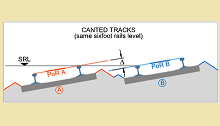
General considerations The relative position of  railway double or multiple adjacent lines is of critical importance for level crossings. On canted tracks, the road traffic is affected if the level crossing does not provide a good riding plane, especially for long vehicles or the (sometimes expensive) low profile ones. This is why the design of…