Significance of jointed track parameter variation

Joint resistance The normal rail joints are designed to allow the rail length variation due to temperature. To do this the joints have a well-defined maximum gap and a set of installation parameters to provide an optimum behaviour at temperature variation and a good maintenance regime. Any modern rail joint has a standard bolt tightening torque…

Types of versines used for track realignment methods

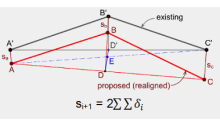
There are three types of versines used for the track realignment and rectification methods (Radu, 2003): Measured (existing) versine – the versine measured with a real chord on the outer rail of the real existing track. This is the result of the versine (Hallade) survey and based on it are computed the track offsets (slues…

Jointed track breathing

Rail breathing Normally on the railway track the rail is fixed through a set of superstructure elements (fastenings, sleepers, ballast) that opposes the rail tendency to expand or contract due to temperature variations. This fixation is achieved through friction forces and once the rail axial forces are above these friction forces, the rail will start…