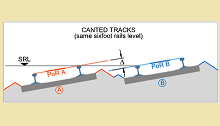
Relative position of adjacent tracks

General considerations The relative position of  railway double or multiple adjacent lines is of critical importance for level crossings. On canted tracks, the road traffic is affected if the level crossing does not provide a good riding plane, especially for long vehicles or the (sometimes expensive) low profile ones. This is why the design of…

The Clothoid

INTRODUCTION In transportation infrastructure design the route is defined based on its axis (centreline) – the alignment model. This simplified abstract model is designed in such a way to clearly define the principle course of the infrastructure project. For most of the transportation means the infrastructure alignment design is split into two main two-dimensional complex…

The limits of vertical acceleration

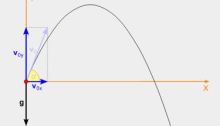
The theory of vertical movement. The parabolic projectile motion An object thrown in the air, near the earth’s surface, moves along a parabolic path under the action of gravity only. The only force of significance that acts on the object is gravity, which acts downward to cause a downward acceleration. Because of the object’s inertia, no external horizontal force is needed…

British Railway Track

Another classic book it sure is “British Railway Track Design, Construction and Maintenance”, edited by Geoffrey H Cope and having around 40 contributors for writing the 30 chapters of this essential track compendium. Its last six edition was published in 1993 by The Permanent Way Institution. Presenting the essential principles but also the British specifics…

La voie ferrée

When it comes to Railway track engineering literature, there are a few books we can consider “classic”. Even old, some very old, these books still have significant railway engineering value and can be always a good reference both for young and inexperienced engineers as for the ones that already have robust railway track experience and…

Maximum joint expansion gap

  A rail joint is a track component that connects two pieces of rail and it provides room for rail expansion and contraction due to the changes in temperature. The mechanical rail joint is designed to allow a gap variation and, as such, has two well defined limits of this gap. The minimum gap of a mechanical rail…