When can a rail be called long?

Thermal expansion When exposed to temperature variations, the rail tends to vary its length. If this tendency is freely allowed, for a temperature variance Δt°, the rail length L will vary by ΔL. This length variance can be computed as: ΔL = αLΔt° In this formula, α is the steel expansion coefficient = 11.5·10−6 mm/mm°C. If…
Relative position of adjacent tracks

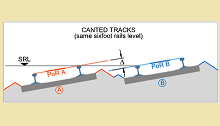
General considerations The relative position of  railway double or multiple adjacent lines is of critical importance for level crossings. On canted tracks, the road traffic is affected if the level crossing does not provide a good riding plane, especially for long vehicles or the (sometimes expensive) low profile ones. This is why the design of…

The Clothoid

INTRODUCTION In transportation infrastructure design the route is defined based on its axis (centreline) – the alignment model. This simplified abstract model is designed in such a way to clearly define the principle course of the infrastructure project. For most of the transportation means the infrastructure alignment design is split into two main two-dimensional complex…

Circle or “egg”?

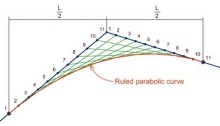
After the post about the limits of vertical acceleration, and even before, I was asked what was the original curve used to connect vertical gradients. What was first, the circle or the “egg”- the parabolic curve? The expected answer was “the circular curve” because, presumably, a circle can be drawn easier than a parabola… “How…