T.L.D.R.: A spade is a spade. “Virtual Transition” is the wrong term for the alignment point where the curvature changes suddenly, without transition. A more appropriate term is “spot radius change”.
The original VT
Definition: The virtual transition is the name given to the ‘transition effect’ formed by the bogie centres of a vehicle when traversing between two elements not joined by a geometrical transition.
Initially, we, the permanent way engineers, called “virtual transition” this effect of the vehicle, turned into a track geometry calculation model, somehow forgetting this effect is not equally distributed inside the vehicle, entirely absent above the bogies, and negatively exaggerated beyond them.
Terminology confusion. A tale of (at least) two VTs
In time some other meanings emerged … We ended up calling “virtual transition” (or VT) also the point where this miraculous effect appears, the point where the curvature suddenly changes.
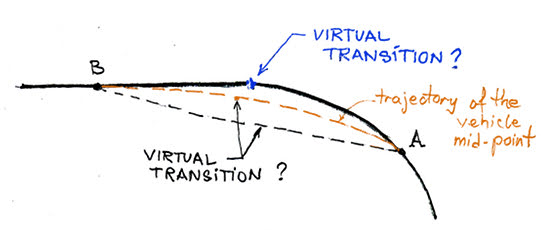
We called “virtual transition” also the shortest possible length of the said vehicle – in the UK 12.2m (or 10.7m, or even 17m if it is to design a second high speed line), 15m in Australia and New Zealand, some other value in India and so on, in the few other countries (are there any others?) where the concept is used.
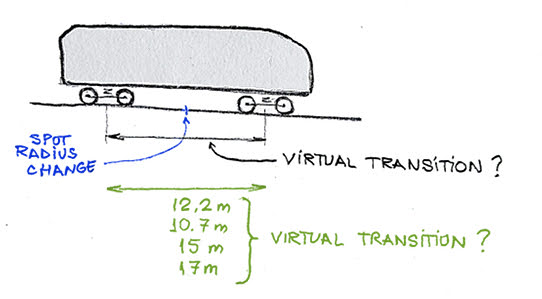
We use the same term, “virtual transition”, to name the effect, the vehicle length, the calculation principle and even the geometrical point where the curvature changes.
We derived from these VTs other obscure concepts (subjects of future PwayBlog twists).
And today this virtual transition terminology confusion makes sense. To us, at least. Somehow…
You see, dear reader, for an experienced permanent way engineer this reads all right:
“Before moving to the UK, I didn’t know anything about virtual transitions, and I never used them, even though I used virtual transitions very often in my designs. At those points, instead of using the virtual transition I used the abrupt change of cant deficiency to evaluate if I need or not a transition. My designs then, without using the virtual transition, had more virtual transitions at high speed and far less at low speed.”
A challenge to the principle of virtual transition?
If you don’t yet see one of my problems for challenging the virtual transition, let me say this:
If I want to challenge the “virtual transition”, and propose to get rid of the virtual transition, I end up demonstrating that very often the virtual transitions are not that bad and we will use more virtual transitions, by removing the virtual transitions. But if we keep them, we will still use virtual transitions where we should not have virtual transitions…
I can’t even write this right!
The point is that the point where the curvature suddenly changes is real, not “virtual”, it is a point not a transition, so calling it “virtual transition” is clearly wrong.
And the confusion in terms between the geometrical point and the other meanings of the term “virtual transition” makes challenging this design rule difficult to define and explain.
Spot radius change? Tangent point?
I was told that before this generalisation of meaning, the point where the radius suddenly changed, with no transition, was called “spot radius change”.
Sounds a bit rough but right.
Tangent point?
These are everywhere … in a real alignment. Tangent point is a more general term, perhaps not the right one. I like it more, but I’ll stay, at least for now, with spot radius change.
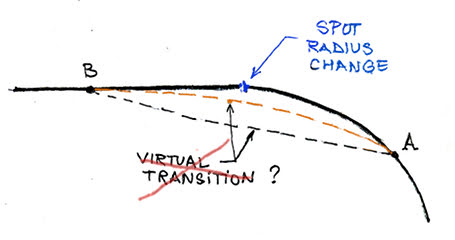
For the track alignment point where the radius suddenly changes, “spot radius change” is for sure a better name than “virtual transition”.
The challenge …
Watch me using the term “spot radius change” instead of “virtual transition” (or at least trying to do that), Thursday 11th June 2026, in a West of England RailEI section presentation called “Why PVT is not the MVP – Challenging the Principle of Virtual Transition” (follow the links for online invite details – meeting open to members and non-members of RailEI).
Discover more from A railway track blog
Subscribe to get the latest posts sent to your email.


