Calculus is (not) scary. Derivatives
One fundamental “difference” between pure science and engineering is the way the second deals with absolutes, unknowns, infinities and other such theoretical concepts, irrelevant, difficult or dangerous to materialise in an engineering construct and project.
The engineer uses empirical rules, simplifications, discrete methods, to avoid or overcome these problems.
One cause of infinities is the derivative function – the mathematical calculation that measures different degrees of instantaneous rate of change.
Even though in engineering we very often don’t explicitly refer to this scary mathematical concept of derivatives, we use them almost every day in our engineering calculations. And almost every day we discretely sort out the infinities they hide.
Track alignment and derivatives
In track alignment design for example, we use mathematical concepts as direction or curvature; these concepts are derivatives from high mathematics (calculus) perspective, and the alignment design theory had to define rules and simplifications to deal with the infinities derived from these derivatives.
Sometimes we just ignore the infinite values of too high degree derivatives – for example we (almost) never care in the track design about the infinite values of the second derivative of curvature at both ends of a Clothoid transition (see figure 1) [1]. This graph alone deserves a separate very long post about track alignment theory – see the European norm Appendix for details.
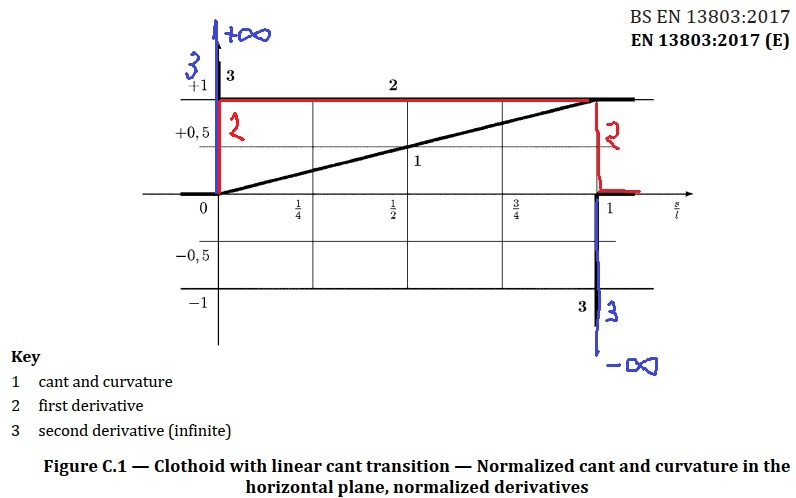
Among these derivatives there are two track design parameters we explicitly refer to as “rate of change”: the rate of change of cant and the rate of change of cant deficiency. The first one, the rate of change of cant, can never, in any point, be infinite by design. The second however …
The infinite RcD
The rate of change of cant deficiency is a derivative measure of curvature (or directly related to it when cant is also involved – rough simplification, I know, but let’s agree to ignore the changes in cant for the sake of this article clarity and length).
At a point of sudden change of curvature (“Spot Radius Change” or “Virtual Transition” if you still want to use the wrong term) the rate of change of cant deficiency is infinite, as derivative of curvature.
No matter how big or small the curvature change is, at a “Spot Radius Change” the mathematical correct value of the rate of change of cant deficiency (RcD) is infinite.
Don’t raise your eyebrows, dear reader! I see you!
It is not only me that is saying this, it is also a well known track standard and design handbook [2]:
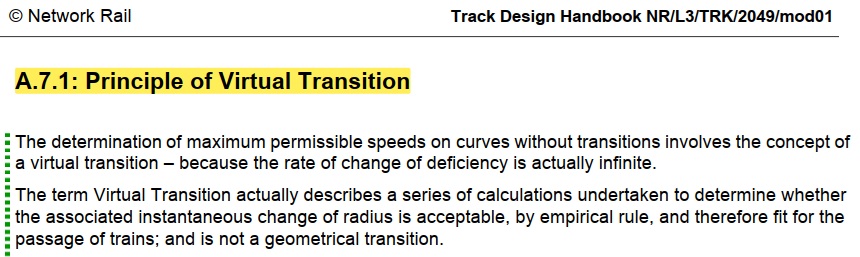
” The determination of maximum permissible speeds on curves without transitions involves the concept of a virtual transition – because the rate of change of deficiency is actually infinite. The term Virtual Transition actually describes a series of calculations undertaken to determine whether the associated instantaneous change of radius is acceptable, by empirical rule, and therefore fit for the passage of trains; and is not a geometrical transition.” [NR/L3/TRK/2049/Mod01 A.7.1]
I said it once before, I’ll say it again here: I want to express my deepest gratitude and admiration for whoever put this in writing in TRK/2049. Many, many thanks!
Because, it is true! Is is also a very clear and accurate statement from track alignment design theory perspective.
RcD is the change in cant deficiency divided by a “length”. At a spot radius change, that “length” is zero (there is no 12.2m on site), hence, RcD = ∞ (see figure 3).
Infinite! Immeasurable! Without end! Infinite for real!

So, what’s the trick the pway engineer invented here?
“Let’s divide that change of cant deficiency by a standard length. And let that length be 12.2m.”
There is a calculus explanation for this mathematical trick of overcoming infinity, the difference between “discrete” and “derivative”, but I will not bother you with that.
What we ignored in defining this “discrete” trick is that this standard length, 12.2m in the UK, is not constant from an RcD perspective. And not because it differs from one vehicle to another! No!
The rate of change of cant deficiency, measured in … mm/s, is the variation of the lateral acceleration (expressed in mm, as cant deficiency) in TIME not in SPACE.
When this virtual transition empirical rule was defined, we should have not used a length (12.2m, 10.7m, 15m or whatever) but a time duration.
The vehicle length never had anything to do with it (I’m simplifying here… but it is true).
If the vehicle length would have been that significant for passage over a spot radius change then we would have had longer vehicles for high speed lines, maglevs and hyperloops. We don’t. WE DON’T!
The challenge
If you want to know how this story ends, join me Thursday 11th June 2026, from 13:00 UK time, for a West of England RailEI section presentation called “Why PVT is not the MVP – Challenging the Principle of Virtual Transition” (follow the link above for online invite details – meeting open to members and non-members of RailEI).
Post scriptum:
Another interesting case of infinity is the first principles design of a switch, because at the toes we have a sudden change in direction called “entry angle” and, by the logic above, the curvature (the direction angle derivative?) at that point is infinite. Infinite curvature means the radius has an instantaneous zero value, exactly at the switch toes. Not a straight (infinite radius) but a “brutal” and abrupt bearing change (radius is zero, no curve direction smoothing).
References:
- BS EN 13803:2017 (2017) Railway applications – Track – Track alignment design parameters – Track gauges 1435 mm and wider, The British Standards Institution
- NR/L3/TRK/2049 (2016) Track Design Handbook, Module 1, Network Rail
Discover more from A railway track blog
Subscribe to get the latest posts sent to your email.


 A railway track blog
Hi Alan. Thanks for your comment. My engineer point of view is that for this subject we got dragged for years into a too scientific/theoretical debate about jerks, frequencies and other such things of perhaps infinitesimal relevance, forgetting basic engineering concepts which once were criteria of competence.
If you can, please attend my presentation. Thanks again for your comment.
LikeLike
… and speaking as a pure scientist, we recognize the limit of applicability of our model. In this case, it means that it’s no longer the static alignment of the track, but rather the dynamic behavior of the vehicle that needs to be modelled. The virtual transition and instantaneous change in can’t deficiency are two different implementations of a cutoff, the assumption being that the vehicle elasticity, track elasticity,and shift in wheel-rail contact will handle the instantaneous change.
A more detailed analysis would need to look at a Fourier analysis of the various elastic elements involved, in particular the suspension of the rail vehicle, it’s natural frequency and damping. The fact that a frequency is involved supports your contention that time, rather than car length, should go into the calculation.
There’s one other consequence. If two transitions are located in time on the order of the natural frequency or damping time, the excitation to the lateral acceleration of the passengers can add coherently, making for a less comfortable experience. This can sometimes be seen, especially in North America, when vehicles with fairly soft suspensions navigate switches.
LikeLiked by 1 person