Where’s the point?

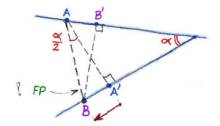
All the railway networks have design rules for marking the limit from which it is safe to stable a vehicle on a line, without the risk of obstructing the train passage on the other line of an S&C (turnout or whatever other arrangement). In the UK this limit comes in a pair – Fouling Point…

And I wonder, still I wonder, who cut the rails?

Aren’t the adjustment switches some really nice devices? On one side we have rails subjected to thermal stress, tending to seriously expand or contract due to the environment temperature, and on the other side no stress is transferred. Smart! We cut the rails in that funny shape, grease the clamp plates, and we let the…

Three points = a circle

A few years ago (2000 or about then – the year 2000, I mean) I was charmed so much by a new and interesting software that I decided to learn it by myself.  I printed its help and started to learn and do things with it.  Long time ago, when it didn’t have ActionScript, it…

Train driving regimes and equilibrium speed

In my previous posts I lightly covered: The various combinations of these forces define the train driving regimes. These are the following (not sure if all the railway networks are defining theme in the same way): A particular case of this regime is where the falling gradient is so steep that it requires the train…

Brake force

And then we have the braking force – the third type of force that influences the train movement. As with the others, this force also depends on speed – mainly due to the speed variation of the friction coefficient (μ) for various brake systems (the forces K that trigger the friction are generally the same):

The Resistance

Before reading this, I recommend reading the previous post – The Traction Force – including its disclaimer.  When a railway vehicle is required to move on track, it needs to overcome a series of resistance forces. We can call the resultant R of all these forces “the running resistance of the vehicle”. If we consider…

Traction force

I’m on my way to explain the principle curvature equivalent gradient. As this is related to a discipline I enjoyed, I choose to go the long way and start with the FORCE. But, before that, a few words of caution: Disclaimer Take this post, and any other that I will write on this subject, with…