
snippet – Swiss CRT
It was very nice to find this in a standard. Snippet taken from here.
It was very nice to find this in a standard. Snippet taken from here.

I mentioned in a previous article, The Cubic Parabola – a complicated simplification, that the curvature diagram of the Cubic Parabola increases linearly up to a peak point and then drops down. Only that first section of the parabolic curve can be used as an alignment transition. The curvature diagram of the Clothoid is however…

Prologue One of the giants on whose shoulders stood proudly Isaac Newton, is the French mathematician Renatus Cartesius. He was the first to label the unknowns in equations by the letters X and Y and also he defined the annotation of powers as superscripted labels X2 . Believe it or not, that was a giant…

Ten years ago, one of my first British friends asked me “Why 4°?” The Clothoid is by far the most used transition curve for railway and highway alignment design. I wrote about this marvelous curve in an old article on this blog – here. Although the Clothoid is the ideal transition for linear variation of…

If we consider a circular curve of radius R2, tangent to a straight and mark the offsets O1, O2 and O3, measured perpendicular from the circle to the straight and placed at regular C/2 interval we will get something like this: The offsets O1 and O3 are the bases of a trapezoid and O2+V2 is…
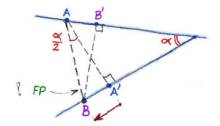
All the railway networks have design rules for marking the limit from which it is safe to stable a vehicle on a line, without the risk of obstructing the train passage on the other line of an S&C (turnout or whatever other arrangement). In the UK this limit comes in a pair – Fouling Point…

Aren’t the adjustment switches some really nice devices? On one side we have rails subjected to thermal stress, tending to seriously expand or contract due to the environment temperature, and on the other side no stress is transferred. Smart! We cut the rails in that funny shape, grease the clamp plates, and we let the…

… or – How to convert a curve into an angle? In the track design handbook we have a too complex formula that refers to “degree of curvature”. Before discussing about the equivalent gradient, let’s see first what this is – what is the degree of curvature? This measure is used in United States in…
 A railway track blog